Understand currency risk as a UAE expat. Separate fund labels from exposure, test future spending needs and ask better questions about matching and hedging.
A portfolio can look stable in dirhams while becoming less able to pay a bill in pounds or euros. For an expatriate family, the useful currency question is therefore practical: will the money available still cover the spending it is meant to fund?
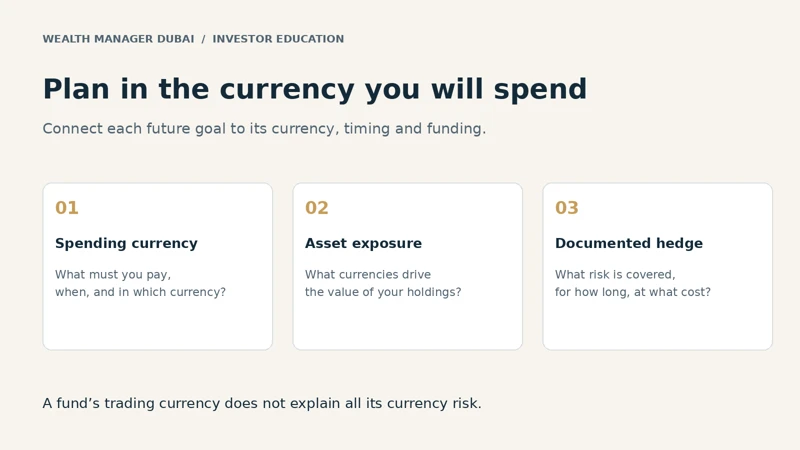
Original conceptual illustration. No client data or market quotations are shown.
To assess currency risk, list each goal’s amount, date and spending currency, then compare it with the currency exposure of the assets and income assigned to that goal. Separate the currency shown on an account or fund label from its underlying investments and any documented hedge. Test adverse exchange-rate scenarios before deciding whether a change is appropriate.
This guide explains that process without forecasting exchange rates or recommending a particular currency, fund or hedging transaction.
Start with the bill, not your passport
Citizenship, current residence and future spending may point to different currencies. A family living in Dubai might have everyday costs in AED, an education commitment in GBP and a possible retirement in EUR. Calling one of these the “home currency” can conceal the others.
Build a short goal register. For each commitment, record:
- The estimated amount in the currency actually payable
- The payment date, or range of dates
- Whether the amount and destination are confirmed or provisional
- Assets already earmarked for it
- Income expected in the same currency before payment
- The consequence of a funding shortfall
Keep uncertain plans visible. “Possible retirement in Europe” should not become a precise euro obligation simply because a spreadsheet requires a number. Use alternative scenarios and revisit them when the destination becomes clearer.
For each goal, also distinguish an exchange-rate problem from an insufficient-savings problem. Changing currency cannot make an underfunded plan adequately funded by itself. The wider portfolio review checklist for UAE expats helps place this work alongside risk, diversification and access to money.
What the AED–USD peg does and does not tell you
The Central Bank of the UAE describes how it intervenes to maintain the dirham’s peg against the US dollar. That is an important part of the current monetary framework. It does not mean that a dirham balance has a fixed value against sterling, the euro or every other currency. See the CBUAE’s explanation of foreign-exchange operations.
For a GBP commitment, the relevant question remains how many dirhams will buy the pounds needed at the payment date. A USD-denominated asset does not automatically solve that mismatch. Its investment value can also move independently of exchange rates.
Do not confuse the monetary framework with a guaranteed retail conversion quote. A bank or transfer provider’s executable rate, spread and fees must be checked separately. Nor should a long-term plan assume that any policy arrangement is an irrevocable promise.
Four currency labels to separate
A statement may show several currency labels that answer different questions. Read them separately rather than treating the most prominent one as the complete exposure.
1. Your reporting currency
This is the unit used to add up and present portfolio values. Translating an account into AED makes comparison easier, but the translation does not change what the account owns.
Keep the original valuation currency and the conversion rate used. Otherwise, two reports prepared on different dates can appear inconsistent even when neither contains a trading error.
2. The fund or share-class currency
A fund or share class may calculate and publish its net asset value in a stated currency. That label alone does not establish that its investments are all in that currency or that exchange-rate exposure has been hedged.
Check the exact share class and its documents. Similar fund names can represent different currency arrangements.
3. The trading currency
For an ETF, this is the currency used to buy or sell a particular exchange listing. Choosing a GBP trading line does not, by itself, turn an internationally invested ETF into a portfolio whose underlying exposure is entirely sterling.
iShares’ global-investing guide explicitly distinguishes the currency used to trade an ETF from exposure arising through its holdings. Its account and tax examples are UK-specific; the currency distinction is the point relevant here.
4. Underlying exposure and hedging
Look through to the assets and the documented hedging policy. For a simple foreign-currency cash balance, the denomination is clear. A global equity portfolio is more complex: the companies themselves may earn revenue, incur costs or borrow across currencies.
HSBC UAE’s discussion of FX in portfolio construction explains that hedging denomination exposure does not remove all the economic effects currency movements can have on businesses. Avoid converting an incomplete holdings list into a falsely precise currency-risk percentage.
A fictional GBP goal stress test
Suppose a family has a fixed GBP 100,000 payment and has earmarked AED 500,000 for it. The following rates are invented teaching scenarios, not current quotes or forecasts. The AED pot and GBP bill remain unchanged.
- At AED 5.00 per GBP 1: the bill costs AED 500,000. The earmarked pot exactly matches the bill before costs.
- At AED 5.50 per GBP 1: the bill costs AED 550,000. The same pot leaves an AED 50,000 shortfall.
- At AED 4.50 per GBP 1: the bill costs AED 450,000. The same pot leaves an AED 50,000 surplus.
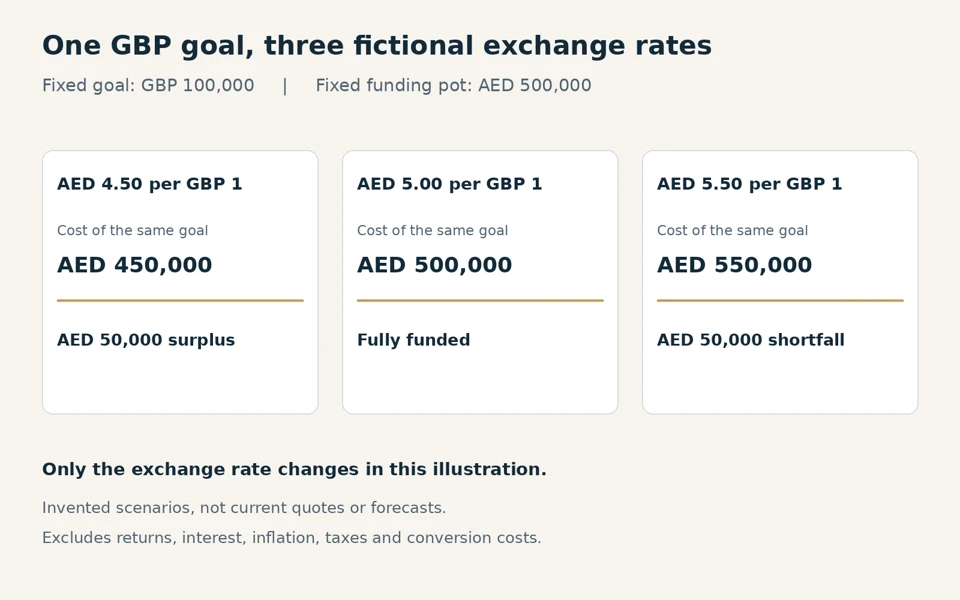
Illustrative exchange rates only. Not a forecast or current market quotation.
The calculation is the GBP obligation multiplied by the number of AED required for one GBP. Stating the quote direction matters: confusing pounds per dirham with dirhams per pound reverses the operation.
This illustration excludes investment returns, interest, inflation, taxes and conversion costs. It isolates the exchange-rate mismatch. Real planning must add those other factors and allow for changes in the bill itself.
The exercise does not tell the family to convert everything today. It reveals a concrete decision: could they absorb a higher AED cost, and what evidence should inform any plan to reduce that uncertainty?
Compare possible responses without predicting the market
The appropriate response depends on the goal, its timing and the household’s wider position. Three approaches can be discussed with a qualified adviser.
Match confirmed spending with suitable resources
Assets or dependable income in the spending currency can reduce a mismatch. Check availability and timing, not just denomination. A future GBP receipt that arrives after the bill cannot fund it on time; the same receipt should not be counted against two goals.
Currency matching also leaves other risks. An investment can be denominated in the right currency and still fall in value, become difficult to sell or mature too late. Cash arrangements need their own checks on access, provider risk and applicable protections.
Use a documented conversion plan
Where a future payment is sufficiently clear, discussing planned conversion dates or stages can replace repeated attempts to guess the ideal market level. Staging can spread the timing of conversion, but cannot guarantee a better rate than a single conversion or eliminate the risk on the amount still unconverted.
Include execution costs and practical constraints. Compare the total amount that will arrive in the destination currency, not only the advertised transfer fee. Record who will authorise the conversion and what would trigger a review of the plan.
Consider hedging where suitable
Some fund share classes use financial contracts to reduce specified exchange-rate exposure. Vanguard’s explanation of hedged and unhedged share classes notes that hedging cannot eliminate all currency risk and can produce a different outcome from remaining unhedged.
Ask what is hedged, into which currency, to what extent and at what cost. A hedge into USD does not establish that a GBP spending goal is protected. It also does not protect against the underlying investment falling in value.
Friends Provident International’s currency-hedging explanation describes additional costs and imperfect hedging. It is a provider’s educational explanation, not a recommendation or evidence that any particular product is available or appropriate for you.
Direct derivatives require separate assessment of terms, obligations and risks. Do not assume a contract is suitable merely because it contains the word “hedge”.
Review returns in the currency that matters to the goal
A positive return in one currency can become a smaller gain or a loss when expressed in another. The SEC’s international-investing bulletin identifies exchange-rate movements as a factor that can increase or reduce investment returns.
For a goal funded in another currency, ask for a consistent view in both the portfolio reporting currency and the spending currency. Use the same dates and make contributions, withdrawals and costs clear. The guide to investment performance reports explains the wider measurement issues.
Avoid changing the reporting currency simply to present the most flattering result. A review should show whether the plan is better funded, not merely whether one translated number looks larger.
Questions to bring to your next review
Bring current statements, exact fund/share-class identifiers, relevant factsheets and a goal register. Ask:
- Which currency exposures are documented, and which remain estimates?
- Which near-term commitments have an uncovered mismatch?
- What would an adverse exchange-rate move mean in money?
- What does each existing hedge cover and leave exposed?
- What would a proposed change cost, and what new risks would it introduce?
- When should the analysis be revisited if our plans change?
Wealth Manager Dubai’s portfolio-management service lists currency and liability matching among its planning areas. You can request a consultation to discuss how these questions fit your wider arrangements.
Frequently asked questions
Does holding USD remove currency risk for UAE expats?
No. The AED–USD peg is relevant to those two currencies under the current framework. A future GBP or EUR bill still creates a separate exchange-rate question, and a USD investment retains its other investment risks.
Is a GBP-traded ETF automatically protected against currency movements?
No. Trading currency describes the purchase and sale currency of that listing. Check underlying holdings, the exact share class and any explicit hedging policy.
Should every investment be hedged?
There is no universal answer. Consider the spending goal, time horizon, asset type, hedge target, costs and ability to absorb losses. Hedging can reduce a specified risk without eliminating all risk or improving every outcome.
Is currency matching the same as avoiding investment losses?
No. Matching denomination can address one source of uncertainty. Market, credit, liquidity, inflation and provider risks may remain, depending on the arrangement.
Educational information only, not personalised investment, tax or legal advice, an exchange-rate forecast or a recommendation to trade or hedge. Investments can fall in value and you may receive less than you invested. Obtain advice appropriate to your circumstances and relevant jurisdictions before acting.
This article is illustrative content provided for information only and does not constitute financial, tax or legal advice. Tax rules and thresholds change and depend on individual circumstances and jurisdiction. Always seek personalised professional advice.