Review your investment mix, currency exposure, fees and access to cash. A practical portfolio review checklist for UAE expats, with a worked example.
Before changing investments, UAE expats should check the purpose of each holding, their overall asset mix, overlapping exposures, spending currencies, total fees and access to cash. Put every account on the same inventory, identify what has changed in your life, and record the evidence behind any proposed change. Where a decision crosses borders, obtain relevant professional advice before acting.
This portfolio review checklist helps turn scattered statements into a focused discussion. It is designed for internationally mobile families with investments, commitments or future plans in more than one country.

AI-generated editorial illustration. This is an imagined setting, not a client portfolio or the adviser’s office.
The portfolio review checklist at a glance
Use these eight questions to organise the review:
- What is this money for, and when will it be needed?
- Have all accounts, debts and commitments been recorded?
- What is the actual asset allocation across the whole portfolio?
- Where do company, sector, country or provider exposures overlap?
- How do investment currencies relate to future spending?
- What are the ongoing costs and the costs of making a change?
- How much money can be accessed, on what terms and by when?
- What needs clarification or qualified advice before a decision?
Mark each answer documented, needs information or needs specialist review. An unanswered question is an action for the review, rather than a reason to guess.
1. Write down what has changed
Begin with a short household update: expected time in the UAE, possible relocation, major spending, income changes and financial responsibilities. Give each goal an amount, date, currency and priority. If the destination or timing is uncertain, record that uncertainty explicitly.
For example, “retirement overseas” leaves important questions open. “Possible retirement in Spain in eight years; destination undecided; spending estimate still required” gives the review something concrete to resolve.
Investment choices depend partly on the time available and a person's willingness and ability to accept risk. There is no single allocation that fits every goal. Investor.gov's asset-allocation guide explains these relationships.
Ask separately: how would a fall in value feel, and what would it prevent the household from doing? Write down both answers for discussion with the adviser conducting the suitability assessment.
2. Build one investment inventory
Use a common valuation date and a clearly labelled reporting currency. Preserve each account's original currency, valuation date and conversion rate so another person can reproduce the totals. Flag estimates and older valuations.
Copy the worksheet below once for each account or holding. Keep full account numbers and sensitive documents in a secure location, rather than in an email-ready summary.
- Ownership and provider: Account owner, provider's legal name, account type and country
- Holding and purpose: Investment name or identifier, quantity and the goal it supports
- Value and evidence: Statement value, currency, date, source and any valuation uncertainty
- Exposure: Asset class, principal underlying holdings, sectors and countries
- Currency: Account currency, relevant underlying exposure and any documented hedging
- Costs: Product, advice, platform and other charges; what each calculation includes
- Access: Dealing terms, notice, settlement, restrictions and potential exit costs
- Follow-up: Missing document, question, responsible person and response date
Record property, business interests, pensions and employer share arrangements alongside the investment accounts, with their status clearly described. List debts and future funding commitments separately. Avoid counting an asset twice, or treating an unvested award as cash already available.
The result should have a defined boundary: for example, “investment accounts only” or “household assets and liabilities”. That boundary matters whenever a percentage is calculated.
3. Check allocation and hidden concentration
Calculate each asset category as a share of the defined portfolio. Where there is an agreed investment policy, place the current figures beside it. Label mixed funds or unclassified holdings as requiring a breakdown instead of assigning them a convenient category.
Then look through the account names. Two funds can hold the same companies; several investments can depend on the same sector or region. Employer shares deserve particular attention when employment income also depends on that business. FINRA's concentration-risk guidance describes these overlapping exposures.
Ask for a consolidated view of the largest company, sector and country exposures, with the date and coverage of the underlying data. Where information is unavailable, show the gap.
Keep portfolio weights and household context distinct. A 10% holding in an investment account means something different when the family also owns a large business in the same industry. Neither figure, on its own, establishes whether a change is appropriate.
Separate performance from money moving in and out
If the review includes performance, reconcile the opening and closing balances with deposits, withdrawals, income, fees and investment movements. A larger account balance is not, by itself, evidence of investment growth.
Ask for a clearly explained performance report covering the relevant period, with its currency, treatment of cash flows and fee basis stated. Retain the original provider statements behind any consolidated summary. Investor.gov’s account-statement guide explains the separate information that statements contain.
4. Compare currencies with future commitments
Prepare a separate list of expected payments: the amount, due date and currency of each obligation. Examples might include UAE household spending, overseas education fees, a mortgage or a future relocation budget. Label uncertain estimates.
For each investment, ask which currencies affect its value and what any hedge actually covers. Do not assume that the currency displayed on a statement fully answers those questions. Obtain the relevant factsheet or provider explanation.
Exchange-rate movements can increase or reduce the value of an international investment when translated into another currency, as Investor.gov's international-investing guidance explains.
The practical review question is: “If the payment date stayed fixed but exchange rates moved, where would the money come from?” Document the answer and any uncertainty. A currency mismatch merits analysis; the appropriate response depends on the full circumstances.
For context on the service, explore Wealth Manager Dubai's portfolio-management approach, including its stated focus on goals, currency needs, costs and reviews.
5. Make the full cost visible
Request a written cost breakdown covering advice or management, platform or custody, underlying investments, transactions, currency conversion and any applicable performance or exit charges. Separate recurring costs from one-off costs.
For each percentage, identify the amount it applies to and whether another quoted charge already includes it. Adding percentages with different charging bases can produce a misleading total. Compare the written schedule with charges on actual statements, and flag anything that cannot be reconciled.
Fees reduce the money available to earn returns. The SEC's investor bulletin on fees and expenses explains ongoing and transaction costs and the importance of checking disclosures.
If a replacement arrangement is being considered, ask for comparable costs and service scope in writing. A lower headline percentage alone does not establish a better outcome. Record potential transfer, exit and implementation costs separately, and have any tax consequences assessed by the relevant qualified specialist.
6. Test access against real payment dates
For every holding, record the contractual route from investment to spendable money. Include dealing frequency, notice requirements, settlement arrangements, restrictions and any withdrawal charges. Ask what can happen if normal access is disrupted.
Liquidity concerns the ability to buy or sell an investment readily; a difficult sale can involve delay or a less favourable price. Investor.gov's liquidity explanation sets out that distinction.
Put expected payments next to the access terms. If a payment is due on 1 September, a statement saying “monthly dealing” is incomplete evidence: the dealing deadline, settlement and transfer process still need checking.
Useful questions include:
- Is the same cash balance being counted towards two separate commitments?
- Is a payment plan relying on an uncertain bonus or asset sale?
- Are there unfunded commitments that have not entered the cash schedule?
- Who can supply written confirmation of access terms?
The required reserve and liquidity arrangements need individual assessment. This checklist does not set a universal cash percentage.
7. Identify the cross-border and provider questions
Before a move, transfer or disposal, give an appropriately qualified specialist the relevant countries, account structures and proposed action. Ask what information is needed to assess tax and reporting consequences. This article does not determine tax residence, tax liability or the suitability of any wrapper.
Also establish which legal entity provides each service, where it is authorised and whether its permissions cover that activity. Verify the relevant regulator's register and the firm's contact details independently.
For services in the DIFC, the DFSA's unauthorised-business guidance explains why both authorisation and the scope of permission matter. That is jurisdiction-specific guidance; it does not establish the status of a firm elsewhere or endorse any provider mentioned here.
When preparing questions about the business's services and process, read Wealth Manager Dubai's FAQs, then request clarification on anything relevant to your circumstances.
8. Worked example: three findings, no automatic trade
Consider a fictional UAE-based household with investment accounts worth AED 2,000,000 on one valuation date. Property, debts, pensions and unvested awards are outside this example. All figures below are invented to demonstrate the review calculations, not typical costs or recommended exposure levels.
An overlap becomes visible
The household holds AED 240,000 of one employer's shares directly. A fund worth AED 600,000 also has a 10% holding in that company, according to its hypothetical holdings report.
- Indirect exposure: AED 600,000 × 10% = AED 60,000
- Combined exposure: AED 240,000 + AED 60,000 = AED 300,000
- Share of the defined portfolio: AED 300,000 ÷ AED 2,000,000 = 15%
The direct holding alone represented 12%. Looking through the fund adds three percentage points to the measured exposure. The next step is to verify the data and assess the significance, including the link to employment income.
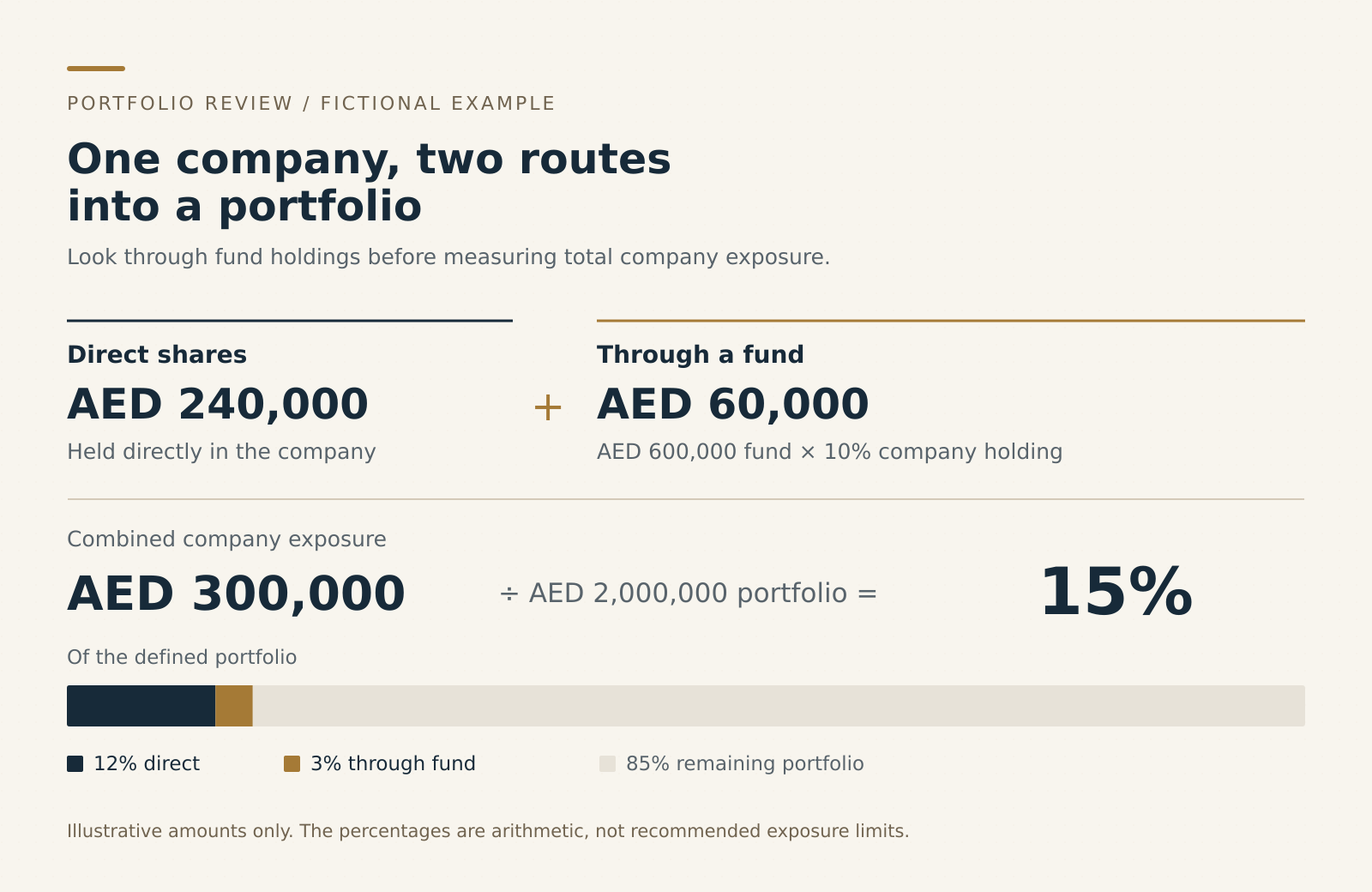
Original illustration using fictional amounts. The percentages demonstrate arithmetic and are not recommended limits.
The cost schedule needs a clear denominator
Assume, solely for this example, that three separate annual charges apply to the same fixed AED 2,000,000 base: 0.50% for management, 0.20% for the platform and 0.25% in weighted underlying fund expenses. None includes another.
Their combined rate is 0.95%, equivalent to AED 19,000 for a year on that unchanged base. This simplified estimate excludes transactions, currency conversion, performance fees, taxes and one-off charges. Actual charges would need checking against their own terms and changing values.
A future payment remains unresolved
The family expects a GBP 40,000 education payment in 18 months, but has not identified its funding source. The review records the amount, date, currency and documents needed. It does not assume that selling the employer shares, switching funds or converting currency is the right answer.
The completed review has three outputs: an exposure calculation, a cost estimate with stated assumptions and an unresolved funding question. Those are useful inputs to advice.
9. Agree review triggers and record the decision
A review can be prompted by a scheduled date, a change in circumstances or a departure from an agreed allocation. Rebalancing means returning towards an established asset mix. Investor.gov discusses both calendar-based and allocation-based review approaches, including transaction costs and tax considerations.
Agree the actual review schedule and any thresholds through the appropriate advice process. Potential events to flag include relocation, an approaching payment, a business sale, a change in income or newly discovered restrictions. A review trigger should lead to assessment, not an automatic instruction to trade.
Use a short decision record:
- Issue: What changed, or what gap was identified?
- Evidence: Which dated statements and documents support the finding?
- Options: What alternatives, including retaining the current arrangement, were assessed?
- Consequences: What costs, risks, access issues or specialist questions remain?
- Ownership: Who will provide the missing answer, and by when?
- Outcome: What was agreed, by whom, and when will it be reviewed?
What to bring to a portfolio review meeting
Bring the completed inventory, recent statements, fee schedules, relevant product documents, the household update and a list of upcoming payments. Add your unanswered questions and the existing investment policy, if there is one.
A useful meeting should leave you able to explain what you own, why you own it, what it costs and what still needs checking. The outcome may be a documented decision to retain the current arrangement, further investigation or a separately assessed proposal for change.
Contact Wealth Manager Dubai to discuss your portfolio-review requirements. Explain the accounts, countries and decisions involved so the scope of any discussion can be established. Ask how to share documents securely before sending statements or other sensitive information.
Educational information only. This article is not personal investment, tax or legal advice, or a recommendation to buy, sell or hold any investment. Investments can fall in value. Obtain advice appropriate to your circumstances and the relevant jurisdictions before acting.
This article is illustrative content provided for information only and does not constitute financial, tax or legal advice. Tax rules and thresholds change and depend on individual circumstances and jurisdiction. Always seek personalised professional advice.