Offshore portfolio bonds can cut tax drag for UAE expats, but traps lurk. Learn when they work, when they don't, and how to audit a legacy plan.

If you are a High-Net-Worth expat in the UAE holding an offshore investment bond arranged years ago by a previous adviser, you may be asking a quiet question: am I paying too much in charges and not getting the tax efficiency I was promised? Offshore portfolio bonds for UAE expats can indeed cut tax drag and simplify cross-border wealth, but only when they are structured transparently and driven by suitability, not commission. This article shows when these bonds genuinely serve internationally mobile families, when they become expensive traps, and why the single most valuable step you can take today is an honest, independent review of the bond you already hold.
Before we unpack the details: if you hold an older bond and want to understand it better, request a private consultation with me.
What Is an Offshore Portfolio Bond?
An offshore portfolio bond is a tax-efficient investment wrapper issued from jurisdictions such as the Isle of Man or Dublin. It holds a range of underlying investments inside one structure, allowing wealth to compound with minimal tax drag. When transparent and suitability-led, it can serve cross-border families well.
In simple terms, it is a single life-insurance wrapper in which you place a portfolio of funds, equities, bonds or other assets. Because the bond is based offshore, typically in a well-regulated, tax-neutral financial centre, any income and gains within it accumulate without being taxed year by year. For a UAE expat whose assets, family and future may span several countries, that tax deferral can make a meaningful difference to long-term wealth.
A good offshore portfolio bond offers open architecture, meaning you are not restricted to a single fund house’s products. You can choose from a wide range of underlying investments, and the costs and fees are clearly disclosed. When I review a client’s existing bond, the first thing I look for is that transparency. Without it, the bond may be working harder for the product provider than for the family it was meant to protect. A deeper look at the structure is covered in our earlier insight, Offshore Portfolio Bonds, Explained.
When Offshore Portfolio Bonds Work
A properly structured offshore portfolio bond can be a powerful tool for UAE expats. I see it work in three specific, connected ways.
Tax efficiency for internationally mobile families
The wrapper’s design is tax deferral. Since you are not taxed on investment income or gains inside the bond while they accumulate, your portfolio compounds faster. For a UAE-based expat who is still tax-resident elsewhere or who may be in the future, this can be vital.
But the real tax value often lies beyond the wrapper itself: where are your underlying assets domiciled? Many expats hold US stocks or US-domiciled funds without realising that, as non-resident aliens, they face a substantial withholding tax on US dividends. Worse, even a modest holding of US-situs assets can expose their estate to US federal estate tax. That is a first-order design constraint for any expat portfolio, as explained in our note on the US dividend and estate-tax trap for non-residents. A well-built offshore portfolio bond can be structured to hold non-US-situs, Irish-domiciled funds, removing that US estate-tax clawback and reducing dividend withholding. In this way, the bond becomes a shield, not just a wrapper.
Estate and succession planning value
For families who plan across borders, an offshore portfolio bond can fit neatly inside a trust structure. The bond can provide liquidity at the right time, help fund estate-tax liabilities and support an orderly transfer of wealth according to your wishes, not probate courts. I regularly work alongside a client’s existing lawyers, trustees and accountants to ensure the bond aligns with the overall succession plan. On its own, a bond does not replace a will or a trust, but when placed inside the right legal framework it becomes a flexible, cross-border asset that serves the next generation.
When the structure is transparent and suitability-led
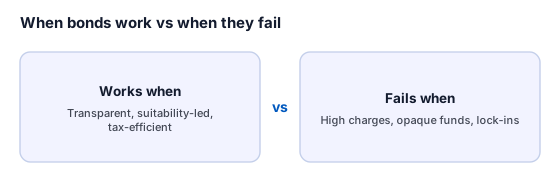
The critical test is whether the bond was built around your goals, your risk tolerance and your multi-jurisdiction reality, or around an adviser’s commission. A transparent bond uses open architecture: a wide choice of funds and assets, with all charges, initial, ongoing and exit, laid out plainly. The advice behind it is suitability-led, meaning it passes rigorous regulatory tests and is documented to show why it is right for you. When I design a bond for a family, I start with a full discovery of their circumstances, not with a product shelf. That is the difference between a tool that works and a tool that costs.
When They Don’t Work: The Commission-Driven Traps
I have seen too many legacy bonds that worked for the seller and not the client. The flaws fall into two clear patterns.
High initial charges and opaque expensive funds
The classic failure: a bond sold primarily because it paid a high upfront commission. To fund that commission, the bond imposes a steep initial charge, sometimes taken from your first contributions over several years. Inside the wrapper, the investment choices are often limited to expensive, in-house funds with high management fees and poor performance. The tax benefit of deferral can be more than wiped out by the sheer drag of fees. When I review such a plan, the real charges are rarely obvious from the annual statement; we have to dig into policy documents and underlying fund costs. The result is a structure that may look like a tax-efficient wrapper but behaves like a wealth-destroying machine.
Multi-year lock-ins and surrender penalties
The second red flag is the lock-in period. Many commission-driven bonds tie the investor’s capital into a multi-year contract with punitive surrender penalties if you try to exit early. I have seen clients who wanted to access their funds for a property purchase or a child’s education only to be told they would forfeit a significant percentage of their savings. The bonds were sold as long-term commitments, but the promised long-term tax benefits did not compensate for the immediate loss of access and liquidity. A genuinely suitable offshore bond should not lock you in so tightly that you lose control of your own wealth. And if a bond is worth keeping, it must also be free to exit on reasonable terms when your circumstances change.
Why Reviewing an Existing Legacy Bond Is the Highest-Impact First Step
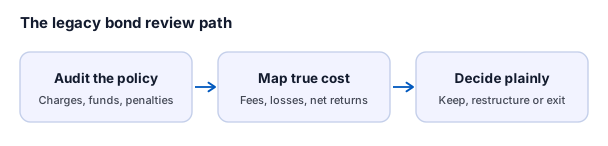
I have spent years untangling bonds that on paper looked complex but in reality were simply expensive. Every expat holding an existing offshore portfolio bond should treat a thorough review not as an afterthought but as the first, and often only, action needed.
What an independent audit covers
When I and my team review a legacy bond, we go far beyond the glossy marketing pages. We obtain the actual policy documents, the full schedule of charges, the underlying fund holdings and any surrender penalty schedule. We then map out the real cost: what you are paying each year in explicit fees and hidden expenses, what you would lose if you left, and what the investments have actually delivered net of those costs. We also look at whether the bond’s structure still fits your current tax residency and future plans, because many expats bought bonds when they were in a different country. We coordinate with your existing lawyers, trustees and accountants so that the review forms part of your complete financial picture.
Keep, restructure or exit
The output of the audit is a plain, honest judgement. In some cases, we recommend keeping the bond because it is competitive, transparent and suitable. More often, we find that the bond can be restructured: the underlying funds can be switched to better, lower-cost options within the wrapper, or the charging structure can be renegotiated or updated. And in the worst cases, the only clear answer is to exit, accept the surrender penalty, cut the losses, and move the assets into a structure that does not penalise the investor. Whatever the verdict, you will know exactly why. You can then book a private meeting on WhatsApp to discuss the findings and plan the next steps. Our offshore investment and portfolio bonds service provides the capability to implement whatever path is right for you.
Offshore Portfolio Bonds vs the Alternatives
Offshore portfolio bonds are not the only cross-border wealth tool, and they should not be treated as a default choice. A direct investment account gives you complete control over individual stocks and bonds but provides no tax deferral and can create complex tax-reporting obligations across jurisdictions. An offshore multi-currency account works well for cash management and liquidity but does not offer the tax wrapper, as we cover in Offshore Accounts for UAE Expats: What They Are (and Aren’t) For. An offshore portfolio bond sits somewhere between: it wraps a diversified portfolio in a tax-deferred environment. It is ideal when you want to defer tax on growth, hold a range of assets inside one structure, and use the bond for long-term wealth transfer. The right tool depends on your goals; a review will tell you whether your current bond is the right tool, or whether a different approach would serve you better.
Frequently Asked Questions
What is an offshore portfolio bond?
It is a life-insurance wrapper issued from an offshore jurisdiction that holds your chosen investments and defers tax on growth until you withdraw.
Are offshore portfolio bonds legal?
Yes. Issued from well-regulated centres like the Isle of Man and Dublin, they are legitimate financial products. They must be declared to tax authorities where required, but they are not secrecy vehicles.
Can you access money early?
Often yes, but it depends on the bond. Many bonds allow partial withdrawals, but some impose surrender penalties if you withdraw within a set number of years. An audit will reveal your specific terms.
How much do they cost?
Costs vary widely. A transparent, suitability-led bond will disclose all charges, custody, administration, underlying fund fees. A commission-driven bond can carry high initial charges and expensive ongoing fees. Review your policy documents.
How do I review my existing bond?
Start with an independent audit. We will examine your bond’s real charges, holdings, penalties and tax effectiveness, then advise you plainly whether to keep, restructure or exit. A confidential assessment is the first move.
Your Next Step
The biggest mistake I see is an expat buying a new offshore portfolio bond without first auditing the one they already hold. Before you add another layer, let us open your existing plan and ask the right questions. I invite you to request a private consultation. In one confidential session, we can review what you have, trace the real charges, and give you a clear recommendation, keep, restructure or exit, with no obligation and nothing to sign.
This article is illustrative content provided for information only and does not constitute financial, tax or legal advice. Tax rules and thresholds change and depend on individual circumstances and jurisdiction. Always seek personalised professional advice.