US-situs assets above $60,000 can expose expats to US estate tax up to 40%. Learn what counts and how to protect your estate.
What Are US-Situs Assets? The Estate Tax Trap

You live in Dubai. You own a handful of US shares in a brokerage account and perhaps a small apartment in Miami that you rent out when you are not there. You think, “I live in the UAE; there is no tax here, so my estate is fine.” That assumption could cost your heirs dearly.
The US federal estate tax reaches across borders for assets it considers “US-situs.” For non‑resident aliens, the exemption is very low.[^exemption-note] Above that threshold, US estate tax can apply at steep rates, and heirs can be forced to sell assets to pay the tax. The point to take away right now is simple: US-situs assets above the minimal exemption can expose a non‑resident expat’s estate to US federal estate tax at potentially high rates, so expats holding US property, stocks or life policies need to know what counts and how to plan around it.
[^exemption-note]: OWNER: Confirm the exact non-resident alien estate tax exemption amount and the top marginal rate. If these figures are correct and may be published, the article can later be updated with the numbers; otherwise the qualitative wording will remain.
If any part of this sounds familiar, you can begin a confidential conversation to review your exposure. No cost, no obligation, just an honest initial view.
What are US-situs assets?
“US‑situs” is the American tax authority’s way of saying that an asset is treated as located in the United States for estate‑tax purposes, regardless of where the owner lives or holds their passport. The concept matters because it determines whether the asset gets pulled into the US federal estate‑tax net when a non‑resident alien dies.
Definition: US‑situs assets are assets the US treats as located in the United States for estate‑tax purposes. For a non‑resident alien, they include US real estate, US stocks and securities, and US life insurance policies. Above a minimal threshold, those assets can trigger US federal estate tax at steep rates.
The list is not infinite. Several commonly held assets do not count, which we will touch on shortly. But first, the three big categories that trip up expats most often.
US real estate
Physical property located inside the United States is unquestionably US‑situs. Whether it is a home in Florida, a condo in New York or a piece of undeveloped land in Texas, the full fair market value counts. Even if the property is held indirectly through a foreign entity, the US tax code can look through the structure to treat the underlying real estate as US‑situs. No surprise that a single property can push an estate past the exemption threshold.
US stocks and securities
Shares of stock in a US company, such as Apple or Microsoft, are US‑situs. The test turns on where the corporation is incorporated: if it is a US‑domiciled company, the shares sit inside the estate‑tax net. The same logic applies to certain US‑domiciled funds and ETFs. Crucially, fund domicile matters. An S&P 500 ETF domiciled in Ireland is generally not US‑situs, whereas one domiciled in the US is. Many expats hold US‑listed securities without realising the fund’s legal home can change the estate‑tax outcome.
US life insurance policies
A life insurance policy issued by a US carrier is treated as US‑situs, regardless of where the policyholder resides. The proceeds themselves may still be payable tax‑free for US income‑tax purposes, but the policy’s value at death can be added to the estate for US federal estate‑tax purposes. For a non‑resident holding a significant US‑issued policy, this can create an unexpected liability that erodes the very liquidity the policy was meant to provide.
The nuance
Not every connection to the US creates a US‑situs asset. For example, US bank accounts maintained in the ordinary course of business are typically not US‑situs, and certain debt obligations may fall outside the net. The bright line remains: real property, corporate stock, and life policies are the core assets to scrutinise.
How the Exemption Threshold Triggers US Estate Tax
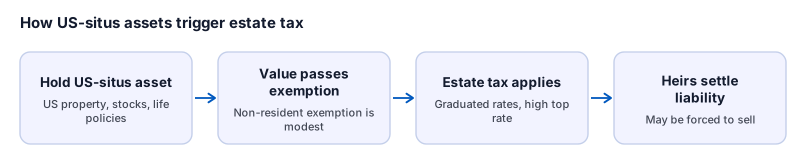
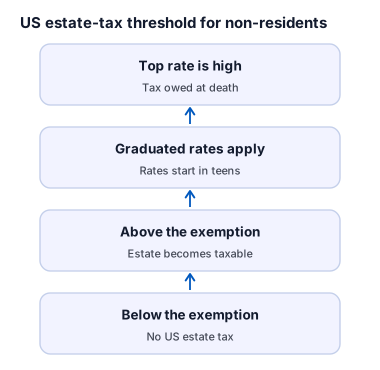
The rule is stark: a non‑resident alien gets a tiny exemption compared with a US citizen or resident. Understanding the mechanics removes the shock and lets you plan.
The non‑resident exemption
Non‑resident aliens are entitled to only a very modest exemption. Above that amount, the estate becomes taxable. By contrast, US citizens and residents enjoy an exemption that runs into the millions. This difference is the central reason that even a modest holding of US‑situs assets can create a tax problem for an expat who lives outside the US.
The rate above the line
Once the US‑situs assets in an estate exceed the low exemption, US federal estate tax is applied at graduated rates that start in the teens and can quickly climb to a high top rate. The tax is calculated on the fair market value of the US‑situs assets at the date of death, not on the original purchase price. A US property that has appreciated in value exposes the full fair market value to the tax, minus the small exemption. The result can be a significant liability that must be paid in US dollars within a relatively short window.
The trap in practice
Imagine an expat who owns a US rental property and a US brokerage account holding US stocks. The combined US‑situs value could exceed the exemption by a wide margin. After the modest exemption, a large portion is taxable, and at a high blended rate the estate‑tax bill could be substantial. Heirs may be forced to sell the property or liquidate investments under time pressure, often at unfavourable prices, just to settle the tax. That is not a legacy most families intend to leave.
Who is at risk: the expat blind spot
Living in the UAE does not immunise you from US estate‑tax rules. The US tax system looks at the situs of the asset, not the country where you pay your rent. I see this blind spot regularly among UAE‑based expats who have built a comfortable life and assume they have left western tax systems behind.
If you are neither a US citizen nor a green‑card holder (the rules for US persons differ significantly), you are a non‑resident alien for US estate‑tax purposes. Your entire exposure rests on whether you hold US‑situs assets. The classic scenarios are:
- A UAE‑based professional who opened a US brokerage account years ago and still holds US equities.
- A business owner who bought a US holiday home and now earns rental income.
- A family that took out a US‑issued life insurance policy to cover a key person or for legacy planning.
In each case, the owner may have no other US connection. It does not matter. The situs of the asset pulls the estate into the US tax orbit.
If you are not certain which of your holdings count, I can discuss this service with you personally. Together we can map your asset positions across jurisdictions and identify where the US estate‑tax risk sits.
How can expats protect an estate from US estate tax?
Planning is possible, and there are several legitimate routes to reduce or remove exposure. The strategies below are illustrative general information, not tax or legal advice. Every family’s situation is different, and the right path depends on the full picture.
Review the treaty position
Some countries have estate‑tax treaties with the US that can raise the exemption or alter which assets are taxable. The UAE, however, does not currently have a comprehensive estate or gift tax treaty with the United States. Without treaty relief, expats in Dubai rely on the structural planning techniques described below. Treating US 30% dividend withholding and 40% US estate‑tax exposure as first‑order design constraints is what makes cross‑border portfolios work properly; when we build a plan, we put tax in the foundation so the portfolio is not leaking value on both fronts.
Choose fund domicile carefully
One of the most impactful changes a non‑resident can make is to hold US‑market exposure through funds domiciled outside the US, such as Irish‑domiciled ETFs. Because the fund is not a US‑situs asset, the holdings sit outside the US estate‑tax net. This approach can remove significant stock and bond positions from the taxable calculation while still giving you the market exposure you want. It requires a deliberate review of your existing holdings and may involve restructuring, but the long‑term saving can be substantial.
Use structures outside the US estate‑tax net
Offshore portfolio bonds and other tax‑efficient wrappers can hold assets in a way that they do not receive US‑situs treatment. When properly structured and suitability‑led, rather than commission‑driven, an offshore bond can offer a transparent, open‑architecture home for a diversified portfolio that stays clear of US estate‑tax reach. I have written more about how offshore portfolio bonds work in a separate insight, “Offshore Portfolio Bonds, Explained”.
Size life cover for the residual tax
Even after restructuring, some US‑situs assets may remain, or a client may choose to keep a US property for personal reasons. In those cases, a carefully sized life insurance policy can fund the expected estate‑tax liability so that heirs are never forced to sell hard assets. The policy provides a defined cash sum at precisely the moment it is needed, preserving the rest of the inheritance. Suitable life cover arrangements, often held within a trust, can be designed specifically around the predicted tax bill. For a deeper look at how to calculate the right amount of cover, see “How Much Life Cover Does a HNWI Expat Actually Need?”.
Frequently asked questions
What is a US‑situs asset?
A US‑situs asset is an asset the United States treats as located within the US for federal estate‑tax purposes. For non‑resident aliens, the main categories are US real estate, shares of US corporations, and US‑issued life insurance policies.
Which assets count as US‑situs for estate tax?
US real property, US corporate stock, certain US‑domiciled funds and ETFs, and US‑issued life insurance policies are the most common. Fund domicile determines whether a fund is US‑situs, not the exchange on which it trades.
Is a US life insurance policy a US‑situs asset?
Yes. A policy issued by a US life insurance company is treated as US‑situs and can be included in the estate of a non‑resident alien for US federal estate‑tax purposes.
Is US real estate subject to US estate tax for non‑residents?
Yes. Real estate located in the United States is US‑situs, regardless of how it is held.
How much can a non‑resident pass free of US estate tax?
A non‑resident alien is entitled to only a very modest exemption. US‑situs assets above that amount are subject to US federal estate tax.
What is the US estate tax rate for non‑residents?
The US federal estate tax applies at graduated rates, with a top rate that can be substantial.
Do expats in the UAE pay US estate tax?
An expat in the UAE who is not a US person can still be subject to US federal estate tax on US‑situs assets. Residence in the UAE does not change the situs of the assets or the estate‑tax rules.
How can non‑residents avoid US estate tax?
Legitimate strategies include selecting non‑US fund domiciles, using offshore portfolio bonds, restructuring holdings to remove US‑situs status, and purchasing life cover to fund any residual tax. Each case is unique, and professional guidance is essential.
Does the UAE have an estate tax treaty with the US?
Currently, the UAE does not have a comprehensive estate or gift tax treaty with the United States. Without treaty protection, expats rely on the structural planning techniques described in this guide.
Conclusion
The story is straightforward: US‑situs assets above a very low threshold can expose a non‑resident expat’s estate to US federal estate tax at potentially high rates. The assets that most often create the problem are US property, US stocks and securities, and US‑issued life policies. The good news is that exposure can be managed through the right fund domicile choices, appropriate wrappers, and targeted life cover, all anchored in a clear understanding of what sits inside the estate‑tax net.
Estate planning is not a do‑it‑yourself exercise, especially when borders are involved. For more on building a lasting succession plan for an internationally mobile family, read “Why Every UAE Expat Family Needs a Succession Plan, Not Just a Will”.
If you would like to review your own position, simply book a private meeting on WhatsApp. I read and reply personally, usually within one business day. A confidential conversation costs nothing but can put a number on a risk you may not have known you were carrying.
This article is illustrative content provided for information only and does not constitute financial, tax or legal advice. Tax rules and thresholds change and depend on individual circumstances and jurisdiction. Always seek personalised professional advice.